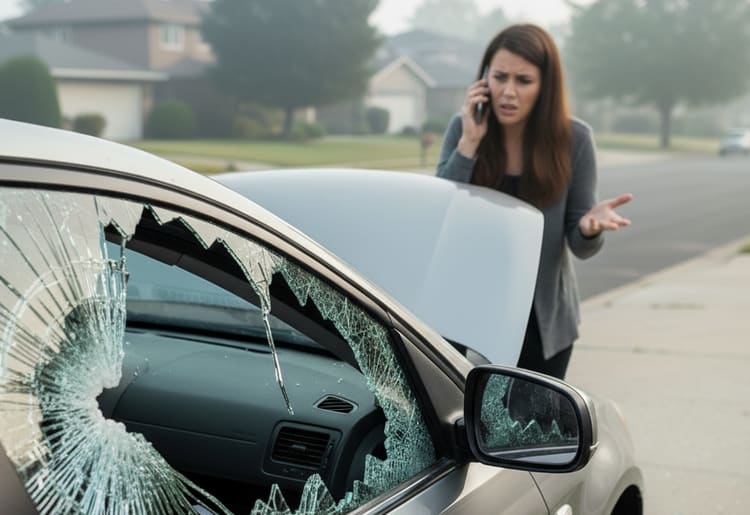
This distinction catches most drivers by surprise when filing
claims.
As an Independent Insurance Adjuster who has processed hundreds of
break-in claims, I've seen countless drivers assume their auto policy covers stolen items, only
to discover they must file through their home or renters insurance. That misunderstanding can turn a
$1,000 theft into a complete out-of-pocket loss.
According to Statista, the average value stolen per larceny-theft incident was around $2,465
in 2023. Before comparing car insurance options, it's important to understand which policies
cover what, how to file claims properly, and how to prevent car theft.
Key Insights
- Auto insurance covers damage to your car (like broken windows), but not the
personal items stolen from it.
- Stolen personal items (like laptops or phones) are covered by your separate
homeowners or renters insurance policy.
- A break-in often requires filing two separate claims and paying two separate
deductibles (one auto, one home).
Different Insurance Policies Cover Different Losses
After a car break-in, you'll work with
two separate insurance policies. Your comprehensive auto insurance covers the car itself (broken
windows, damaged locks, stolen factory equipment), while your homeowners or renters insurance covers
stolen personal belongings that were inside the vehicle.
What's Covered After a Car Break-In
| What Was Damaged or Stolen |
Which Insurance Covers It |
| Broken windows or damaged doors |
Auto insurance (comprehensive coverage) |
| Stolen built-in stereo or navigation system |
Auto insurance (comprehensive coverage) |
| Stolen laptop, phone, or electronics |
Homeowners or renters insurance (personal property coverage) |
| Stolen wallet, purse, or bags |
Homeowners or renters insurance (personal property coverage) |
| Damaged upholstery or interior |
Auto insurance (comprehensive coverage) |
| Stolen aftermarket stereo or equipment |
Homeowners or renters insurance (personal property coverage) |
What Your Auto Insurance Covers After a Break-In
Comprehensive coverage within your auto insurance policy pays for
physical damage to your vehicle caused by non-collision events, including theft and vandalism from
break-ins.
Physical Damage to the Vehicle
Comprehensive auto coverage pays to repair or replace:
-
Broken windows and glass: Smashed windows,
shattered windshields, damaged mirrors
-
Damaged locks and ignition: Drilled-out lock
cylinders, broken door handles, tampered ignition systems
-
Damaged doors and panels: Bent frames,
scratched paint, dented panels from prying tools
-
Slashed convertible tops: Cut or torn soft-top
materials
-
Damaged interior: Torn upholstery, broken
dashboard pieces, damaged consoles
For a simple break-in, replacing a side window and repairing lock
damage commonly runs $400-$1,000, depending on the vehicle and local labor rates.
Factory-Installed Equipment
Comprehensive coverage also replaces permanently installed vehicle
equipment stolen during break-ins:
- Built-in audio systems: Factory-installed
stereos, amplifiers, and speakers that came with the vehicle.
- Navigation systems: Manufacturer-installed GPS
and entertainment displays integrated into the dashboard.
- Built-in security systems: Factory alarm systems
or immobilizers that are part of the vehicle's original equipment.
Your Comprehensive Deductible Applies
Before insurance pays for vehicle repairs, you'll pay your
comprehensive deductible (typically ranging from $250 to $1,000). If repair costs don't
significantly exceed your deductible, filing a claim may not be financially worthwhile.
Where Are My Stolen Belongings Actually Covered?
Personal property coverage in homeowners and renters insurance
policies extends protection beyond your home's four walls, covering possessions stolen from your
vehicle anywhere in the world.
What Does Personal Property Coverage Include?
Standard homeowners or renters policies cover personal items stolen
from your car:
- Electronics: Laptops, tablets, phones, cameras,
and portable gaming devices.
- Personal accessories: Wallets, purses,
sunglasses, watches, and jewelry.
- Clothing and bags: Coats, backpacks, gym bags,
and luggage.
- Work equipment: Tools, briefcases, work
documents, and professional gear.
- Sports equipment: Golf clubs, bicycles, skis, or
other recreational items.
On homeowners' policies, personal property limits are typically
50% to 70% of the dwelling coverage. For example, a $300,000 home limit often comes with $150,000 to
$210,000 of personal property coverage. Basic renters policies frequently include around $25,000 to
$30,000 of personal property coverage.
Coverage Limitations You Should Know
While personal property coverage extends to items in your car,
specific limitations apply:
- Special limits for high-value items: Jewelry,
watches, and firearms often have sub-limits of $1,000 to $2,500 total, regardless of actual value.
- Electronics may have limits: Some policies cap
electronic equipment reimbursement at specific amounts per item.
- Cash limits are low: Stolen cash typically has a
$200 to $500 maximum reimbursement limit.
- Proof of ownership required: You'll need
receipts, photos, or other documentation to verify ownership and value.
The strongest claims are always well-documented. If you routinely
carry high-value items like cameras, laptops, or tools in your car, keep a simple digital inventory:
photos of the items, serial numbers, and receipts stored in the cloud. When a theft happens, that
evidence often makes the difference between a fast, full payout and a drawn-out, reduced settlement.
The Aftermarket Equipment Gray Area
Factory-installed means equipment that came with the vehicle from
the manufacturer. Anything added later, even at the dealership, may be treated as aftermarket. Factory
gear is usually covered automatically by comprehensive insurance, while add-ons often need to be
specifically scheduled or endorsed.
Aftermarket Equipment Coverage
-
Permanently installed equipment: May be covered
if properly declared and added to your policy.
-
Portable equipment: Dash cams, GPS units
typically fall under homeowners/renters insurance.
-
Custom audio systems: Require specific
endorsements on auto insurance.
Standard auto policies cap aftermarket coverage at $1,000-$3,000.
Many insurers offer custom parts and equipment (CPE) coverage with $5,000-$20,000 limits for a small
additional premium.
How to File Claims for Car Break-Ins
Car break-ins require you to navigate two separate insurance claims simultaneously, each with its own process, deductible, and
timeline.
-
File a police report immediately: Before
contacting either insurance company, file an official police report. Document everything, get the
report number, and request a copy for your records.
-
Contact your auto insurance for vehicle damage:
Report within 24 hours, provide the police report number, submit photos of damage, get repair
estimates, and pay your comprehensive deductible before repairs begin.
-
Contact your homeowners/renters insurance for stolen
items: Report the theft within 24-48 hours, provide the police report, list all stolen
items with descriptions and values, submit proof of ownership, and pay your homeowners/renters
deductible separately.
The biggest car insurance mistakes I see
are poor documentation and mixing information between policies. People file with auto, mention the
stolen laptop in passing, and assume that's taken care of without opening a home or renters
claim.
Avoid Filing When You Face the Double Deductible Trap
Because car break-ins trigger two separate insurance policies,
you'll pay two deductibles (one for auto comprehensive coverage and another for
homeowners/renters personal property coverage).
How to Calculate Whether Claims Are Worth Filing
Example Scenario 1: High-Value Theft (Worth Filing)
| Item |
Amount |
| Window repair |
$400 |
| Stolen laptop |
$1,200 |
| Stolen phone |
$800 |
| Total loss |
$2,400 |
| Auto deductible |
-$500 |
| Homeowners deductible |
-$500 |
| Total deductibles |
-$1,000 |
| Net insurance payout |
$1,400 ✓ |
Example Scenario 2: Low-Value Theft (Not Worth Filing)
| Item |
Amount |
| Window repair |
$350 |
| Stolen sunglasses |
$200 |
| Stolen gym bag |
$100 |
| Total loss |
$650 |
| Auto deductible |
-$500 |
| Homeowners deductible |
-$500 |
| Total deductibles |
-$1,000 |
| Net insurance payout |
-$350 ✗ |
Most auto deductibles run $500-$1,000, and homeowners'
deductibles typically hit $1,000. Renters policies usually have a $500 deductible. When you're
filing both claims, you're looking at $1,000-$2,000 out of pocket before insurance pays anything.
That's why smaller break-ins often aren't worth claiming.
Additional Considerations Before Filing
-
Claims impact future rates: Multiple claims can
increase premiums at renewal.
-
Personal property claims are particularly
impactful: Can significantly affect future homeowners insurance rates.
-
Small claims may not justify long-term costs: A
$200 payout today could cost $500+ in higher premiums over 3-5 years.
It rarely makes sense to file unless your total loss is at least 1.5-2
times your deductible per policy. Otherwise, you're trading a small payout today for higher
premiums tomorrow. Always run the math before filing.
How to Prevent Car Break-Ins
Over 20% of
vehicle thefts occur in parking lots and garages, with about 70% happening at night in poorly lit
areas. The National Highway
Traffic Safety Administration recommends parking in well-lit, busy spots as a key deterrent.
Prevention Strategies:
-
Keep valuables out of sight and store items in the trunk before
reaching your destination.
-
Remove visible items like charge cables, GPS mounts, and shopping
bags.
-
Lock doors and windows; never leave keys inside the vehicle.
-
Install visible security systems, steering wheel locks, and dash
cameras.
-
Use VIN etching on windows to reduce resale value of stolen parts.
The Bottom Line: Car Insurance for Car Thefts
Verify you carry comprehensive coverage on your auto policy (it's
optional coverage not included in basic liability-only policies).
Document high-value possessions with photos and receipts before theft occurs, and review both policy
deductibles to understand your out-of-pocket costs.
Take action today by reviewing your auto insurance policy to confirm
comprehensive coverage is active, verifying your homeowners or renters insurance covers off-premises
personal property, and implementing tactics to reduce break-in risk entirely.
Methodology
- Data sources: Average theft values from Statista
2023 data, FBI National Incident-Based Reporting System property crime statistics, and typical repair
costs compiled from insurance industry claims data.
- Expert review: All information verified by Joey
Haddad, Independent Insurance Adjuster, licensed in FL, TX, GA, MI, LA, SC, NC, NM, AL, OR, and WV.
- Verification process: Coverage details and claim
procedures confirmed through major auto and homeowners insurance policy documents, state insurance
regulations, and carrier customer service inquiries.
- Limitations: Deductible amounts, coverage limits,
and claim processes vary by insurer, state, and individual policy terms. Cost examples represent
typical scenarios and may differ by location and vehicle type.
- Transparency note: BestMoney.com is committed to
providing objective, editorially independent content to help consumers make informed insurance
decisions.
Frequently Asked Questions
1. Does liability-only car insurance cover break-ins?
No. Liability insurance only covers damage you cause to others in car
accidents. You need comprehensive coverage (optional coverage beyond liability) to protect your
vehicle from break-ins, theft, and vandalism. Without comprehensive coverage, you'll pay all repair
costs out-of-pocket.
2. Can I claim stolen items on my auto insurance?
No. Personal belongings stolen from your car cannot be claimed through
auto insurance, regardless of what coverage you carry. Without renters or homeowners insurance, you have
no coverage for stolen personal property and must absorb the full loss.
3. Will filing a break-in claim increase my insurance
rates?
Comprehensive claims generally impact rates less than at-fault accidents, but they still affect your claims history. Multiple
comprehensive claims within 3-5 years can increase premiums. The rate impact depends on your insurer,
state, and overall claims history.