We earn commissions from brands listed on this
site, which influences how listings are presented.
Last updatedMarch 2026
Protect Your Family’s Tomorrow, Today
Best Term Life Insurance Companies of 2026
Take the guesswork out of life insurance and protect your
family from unforeseen financial burdens. We compare the top term life insurance companies to help you
choose the best.
Reviewed by
Holly Johnson
Finance and Insurance Expert
Holly Johnson is a money and insurance expert who has covered
personal finance, credit cards and insurance for over a decade. She is passionate about
explaining the ins and outs of financial products to consumers, and is the co-author of "Zero
Down Your Debt: Reclaim Your Income and Build a Life You’ll Love." She lives in Indiana with
her husband and children.
Our product scores consist of a combination of the
following 3 components:
Popularity
BestMoney measures user engagement based on the number of clicks each listed
brand received in the past 7 days. The number of clicks to each brand will be measured against other
brands listed in the same query. Therefore, the higher the share of clicks a brand receives in any
specific query, the higher the Click Trend Score. BestMoney accepts advertising compensation from
companies, which impacts their (and/or their products’) position, and in some cases, may also affect
their Click Trend Score.
Brand Reputation
Semrush is a trusted and comprehensive tool that offers insights about online
visibility and performance. The BestMoney Total Score will consist of the brand's reputation from
Semrush. The brand reputation is based on Semrush's analysis of clickstream data, which includes
user behavior, search patterns, and engagement, to accurately measure each brand's prominence,
credibility, and trustworthiness. If a brand does not have a Semrush score, the BestMoney Total Score
will be based solely on the Click Trend Score and Products & Features Score (read below).
Features & Benefits
BestMoney’s editorial team researches and reviews financial products based on
factors such as: range of products and services offered, ease-of-use, online accessibility, customer
service, special awards, and more. Each brand is then given a score based on the offerings in each
parameter. The specific parameters which we use to evaluate the score of each product can be found on
its review page.
Term life insurance is a type of life insurance that provides temporary coverage for a
fixed period, most commonly 10, 20, or 30 years—and pays a tax-free death benefit if the policyholder
dies during that term. It is primarily used to replace income or cover major financial obligations
during working years.
When you purchase a term life insurance policy, you select a coverage amount, a term length, and one or
more beneficiaries. In exchange for fixed monthly or annual premiums, the insurer guarantees payment of
the full death benefit if the policyholder passes away while the policy is active.
If the term ends and the policyholder is still living, coverage typically expires unless the policy is
renewed or converted to a permanent life insurance policy. Because term life insurance does not include
a cash value or investment component, it is generally more affordable and easier to understand than
permanent life insurance options.
Term life insurance is commonly used for income replacement and mortgage protection insurance, helping
families cover expenses such as housing, education, and daily living costs during high-responsibility
years.
Example: How Term Life Insurance Works in Practice
Sarah is 35 years old, has two young children, and carries a $350,000 mortgage. She purchases a 20-year
term life insurance policy with a $750,000 death benefit and fixed premiums.
If Sarah dies during the 20-year term, her beneficiaries receive a $750,000 tax-free payout that can
replace lost income, pay off the mortgage, and cover ongoing expenses. If she outlives the term, the
policy ends with no payout—because the coverage was designed to protect time-limited financial
obligations rather than serve as a long-term savings vehicle.
Term life insurance offers affordable, temporary coverage and is best suited
for income replacement and protecting financial obligations during working years, while whole life
insurance provides lifelong coverage at a significantly higher cost.
Comparing life insurance policies is essential, as premiums, underwriting
standards, and policy features can vary widely between insurers, even for similar coverage amounts.
Tools like term life insurance calculators and online quote comparisons
simplify the process, helping consumers estimate coverage needs and evaluate options efficiently.
Policy flexibility and insurer reliability matter long term, making features
like conversion options, riders, and strong financial ratings important considerations.
Why Comparing Term Life Insurance Is Important
Comparing term life insurance policies helps ensure your coverage matches your financial
responsibilities, timeline, and budget. While many term life policies provide similar core protection,
meaningful differences exist between insurers that can affect both cost and long-term flexibility.
Life insurance premiums can vary widely based on underwriting standards, even for the same coverage
amount and term length. Policy features such as conversion options, renewal terms, available riders, and
approval requirements can also differ, influencing how well a policy adapts as needs change.
Comparing policies makes it easier to align coverage with real-world obligations, such as income
replacement, mortgage protection insurance, or funding future education expenses. It also helps prevent
common issues like overpaying for unnecessary features or choosing coverage that expires before key
financial responsibilities are met.
Many consumers start this process with a term life insurance calculator or online quote comparison
tools, which provide quick estimates and allow for side-by-side evaluation of pricing and policy
features.
Key Benefits of Term Life Insurance
Term life insurance is best suited for people who want affordable, straightforward coverage during
financially demanding stages of life. Because it focuses on protection rather than savings, it offers
several practical advantages.
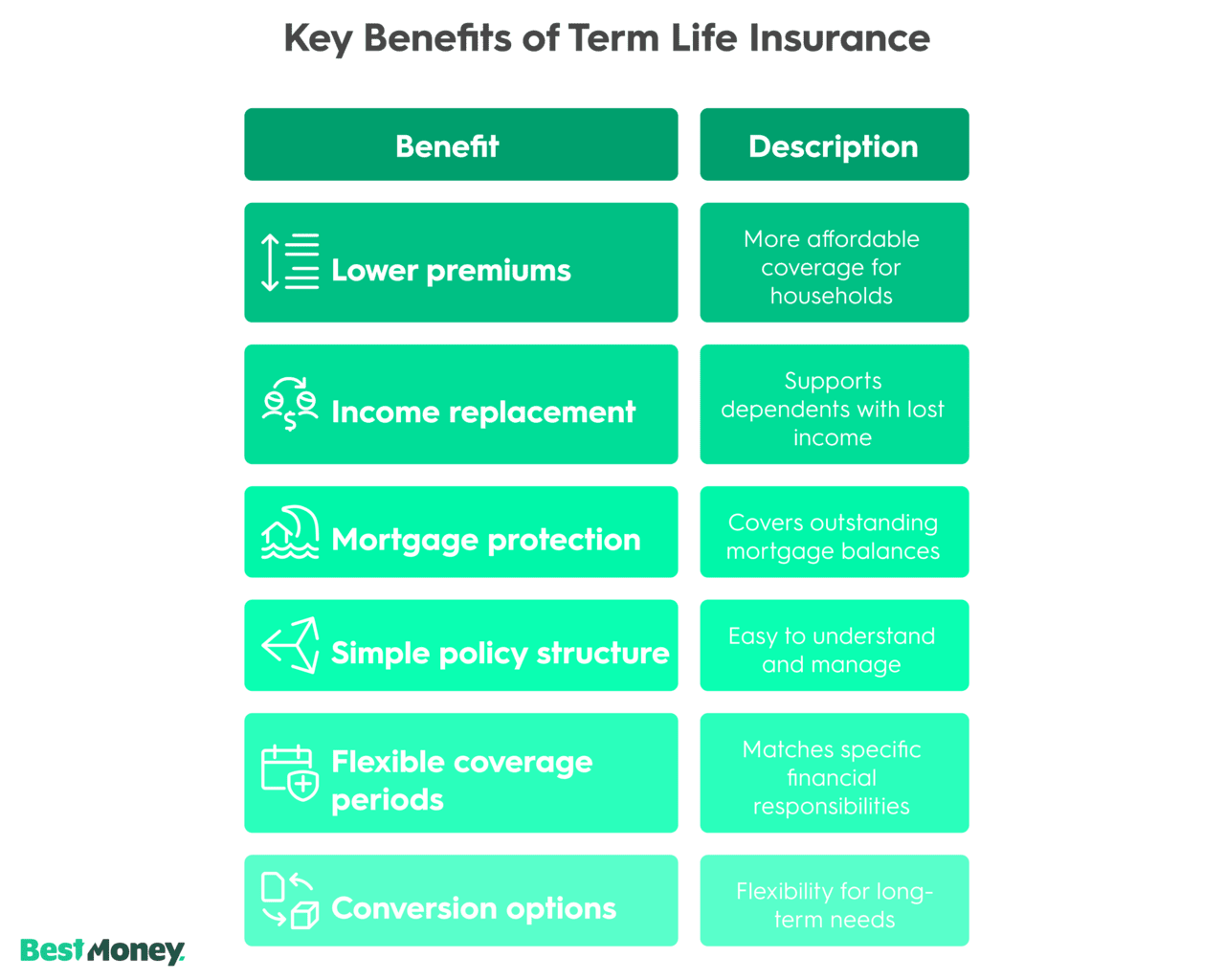
Key benefits include:
Lower premiums: Term life insurance typically costs significantly less than
permanent life insurance, allowing many households to afford higher coverage amounts.
Income replacement: Coverage can help replace lost income, supporting dependents
with everyday living expenses if the policyholder dies.
Mortgage protection insurance: Term policies are commonly used to cover outstanding
mortgage balances and other time-limited debts.
Simple policy structure: There is no cash value or investment component, which
makes policies easier to understand and manage.
Flexible coverage periods: Policies are available in fixed terms (such as 10, 20,
or 30 years) that can be matched to specific financial responsibilities.
Conversion options: Some policies allow conversion to permanent life insurance
later, providing flexibility if long-term needs change.
Together, these benefits make term life insurance a practical option for protecting financial
obligations during working years without long-term complexity.
Expert Tip: A Complete Needs Analysis
"We recommend always speaking with a licensed [life insurance]
advisor who can do a complete needs analysis. Term life insurance is a great product for someone
looking to cover financial obligations or provide income replacement while their children are still
young. A universal indexed life policy is better…[to] leverage a policy…for their kids' college
tuition, business or retirement adventures.”
— Hanna WuCEOAmplify Life Insurance
How to Use a Term Life Insurance Calculator
A term life insurance calculator estimates how much coverage you may need and what your premiums could
look like based on personal details.
Estimate coverage needs: Factor in debts, income replacement, and dependents
Preview premium costs: Rates vary by age, term length, and health
Compare quotes easily: Get accurate life insurance quotes instantly
This tool streamlines your journey to finding the best term life insurance policy.
How to Compare Term Life Insurance Companies
After determining your coverage needs, the next step is comparing term life insurance companies based
on how they deliver that coverage. This stage focuses on differences between insurers, not personal
financial planning.
Key factors to compare include:
Pricing consistency: Premiums can vary significantly between insurers due to
different underwriting models.
Underwriting approach: Approval requirements, medical exams, and data usage differ
by provider.
Policy features: Term lengths, conversion options, renewal terms, and available
riders vary across insurers.
Customer experience: Claims handling, communication, and policy management tools
can affect long-term satisfaction.
Comparing these elements side by side helps identify insurers that align with your coverage
requirements, budget expectations, and preference for flexibility or digital convenience.
Strong customer service reputation and financial stability
Ladder
Adjustable term life
No-exam and exam options
Flexible coverage that can change over time
Ethos Life Insurance
Simplified term & whole life
Primarily no-exam
Convenience and speed-focused
MassMutual
Whole & term life
Exam typically required
Long-term stability and dividends
Fabric by Gerber Life
Term life for families
Exam and no-exam options
Family-focused tools and coverage
SelectQuote
Multi-carrier comparison
Varies by insurer
Broad access to multiple providers
Guardian Life
Permanent life insurance
Exam typically required
High-quality whole and universal life
Fidelity Life
High-risk applicants
Exam and no-exam options
Flexible underwriting for health issues
TruStage
Seniors and AARP members
Often no exam
Easy access for older applicants
How to Buy Term Life Insurance Online in Maharashtra
Buying term life insurance online allows you to compare policies and apply for coverage with minimal
friction.
Most people begin by estimating coverage needs, often using a term life insurance calculator. From
there, you can compare life insurance quotes across multiple providers and complete an application
digitally. Depending on the insurer and policy type, underwriting may involve a medical exam or simply a
health questionnaire.
Online purchasing makes it easier to evaluate options quickly while maintaining control over coverage
decisions.
What is The Difference Between Term and Whole Life Insurance?
The main difference between term and whole life insurance is duration:
term coverage is temporary, while whole life insurance lasts for life.
Term life insurance is designed for affordability and clarity, making it well-suited for income
replacement and time-limited obligations. However, the policy expires at the end of its term unless
it's converted into a whole life policy. If your coverage ends, your beneficiaries won’t receive a
payout when you pass, and you lose all money paid into the policy.
On the other hand, whole life insurance provides permanent, lifetime coverage and includes a cash value
component that grows over time, but at a significantly higher cost.
Feature
Term Life Insurance
Whole Life Insurance
Coverage Duration
Fixed (10–30 years)
Lifetime
Premiums
Lower
Higher
Cash Value
No
Yes
Policy Loans
No
Yes
Complexity
Simple
More Complex
In plain terms: most people choose term life insurance for protection during working
years, while whole life insurance is typically used when permanent coverage or long-term financial
planning goals are involved.
How to Find the Right Life Insurance Coverage for You
Choosing the right life insurance starts with understanding your personal financial responsibilities,
not comparing companies. The goal of this step is to determine how much coverage you need and how long
that coverage should last.
Key questions to consider include:
Who depends on your income? This may include a spouse, children, or aging parents.
How long would financial support be needed? Consider the number of years until
dependents are financially independent.
What financial obligations would remain? Common examples include mortgages, private
student loans, and other outstanding debts.
What future goals should be protected? These may include education costs, final
expenses, or planned legacy contributions.
What premium amount is sustainable long term? Coverage must remain active for
benefits to be paid.
Answering these questions helps determine whether term or permanent life insurance is appropriate,
along with an estimated coverage amount and term length. Once these needs are clearly defined, you are
ready to evaluate insurance providers.
What Reddit Users Say About Finding the Best Life Insurance
To add real-world perspective, we reviewed recent Reddit discussions about choosing life insurance and
comparing providers. Several clear themes came up consistently.
There’s no single “best” life insurance policy
Reddit users often emphasize that the right policy depends on personal factors like income,
dependents, and long-term goals. What works for one person may not work for another.
Term life insurance is commonly recommended for affordable income replacement during working years,
while permanent policies are usually discussed for long-term planning.
Comparing options matters more than picking a brand
One of the strongest takeaways is the importance of shopping around. Prices, underwriting standards,
and policy features can vary widely between insurers, even for similar coverage. Many users recommend
comparing multiple quotes rather than accepting the first offer.
Flexibility is a recurring priority
Flexibility is frequently mentioned, especially conversion options that allow term policies to be
converted to permanent coverage later. Users see this as a way to secure coverage early while keeping
future options open.
Living benefits are a bonus, not a requirement
Some users mention living or accelerated benefit riders, particularly for serious illness. While not
considered essential, these features are often viewed as a useful add-on.
What these discussions reinforce
Overall, Reddit users echo common professional advice: define your needs, compare multiple insurers,
and choose coverage that fits both current responsibilities and future plans.
How Much Does Life Insurance Cost?
Life insurance costs depend on your age, health, coverage amount, and the type of policy you choose. In
general, term life insurance is the least expensive option, while permanent policies such as whole life
insurance cost significantly more due to lifetime coverage and cash value features.
Whole life insurance often costs several times more for the same coverage amount, but your
beneficiaries are guaranteed a payout, so long as the policy remains in effect.
For many people looking for cheap life insurance, term life insurance provides the most affordable way
to secure meaningful coverage. However, affordability should be weighed alongside coverage adequacy and
insurer reliability. Comparing life insurance quotes from multiple providers is the most effective way
to understand true costs for your specific profile.
What Factors Affect Life Insurance Premiums?
Life insurance premiums are determined by how insurers assess overall risk and policy structure.
Several factors influence how much you pay for coverage.
The most common factors include:
Age: Younger applicants typically qualify for lower premiums because they present a
lower risk to insurers.
Health status: Medical history, current conditions, height and weight, and family
health history all affect pricing.
Lifestyle factors: Smoking, high-risk activities, hazardous occupations, and
driving history can increase premiums.
Coverage amount: Higher death benefits generally result in higher premiums.
Policy term length: Longer term lengths usually cost more than shorter terms for
the same coverage amount.
Policy type: Term life insurance is typically less expensive than permanent
policies due to its temporary nature.
Optional riders:Adding riders such as accelerated death
benefits or waiver of premium can increase costs.
Location: In some cases, regional factors such as healthcare access or insurer
pricing models may influence rates.
Understanding these factors helps explain why quotes vary between insurers and highlights why comparing
multiple life insurance quotes is important when evaluating coverage options.
What Are the Benefits of Adding Riders to Your Policy?
Life insurance riders add extra protection by customizing a policy to cover specific risks beyond the
standard death benefit. They allow policyholders to tailor coverage to their personal and financial
circumstances.
Common riders include accelerated death benefits, which allow early access to funds in the event of a
terminal illness; waiver of premium riders, which suspend payments if you become disabled; and
accidental death riders, which provide additional benefits for certain causes of death. Some policies
also offer child riders or critical illness riders.
While riders usually increase premiums, they can provide meaningful value in situations where
additional coverage is needed. Evaluating rider options carefully helps ensure your policy remains
aligned with both current responsibilities and potential future risks.
When Should You Consider Whole Life Insurance Over Term Life?
You should consider whole life insurance if you want permanent coverage with guaranteed premiums and a
built-in cash value component. Whole life insurance is designed to last your entire lifetime, making it
suitable for long-term planning, estate needs, or lifelong financial support for dependents.
Because whole life insurance accumulates cash value, it can be used later in life for loans or
supplemental income. However, these benefits come at a significantly higher cost compared to term life
insurance.
Term life insurance is generally better suited for temporary needs, such as income replacement during
working years or covering major financial obligations. Choosing between the two depends on whether your
priority is long-term permanence or affordable, time-limited protection.
Expert Tip: Term Insurance vs Whole Life Insurance
“Term insurance is more like renting coverage for a period of time. When
that period ends, you no longer have coverage. Whole-life insurance is a contract you own. It will
cost a bit more per year to own whole-life insurance, but it is something you keep for your
lifetime."
– Seth Sherrypractice development coordinatorM&O
Marketing
What Are the Pros and Cons of No-Exam Life Insurance Policies?
No-exam life insurance policies allow applicants to qualify for coverage without completing a medical
exam, relying instead on health questionnaires and data checks. This approach prioritizes convenience
and speed, but it comes with tradeoffs.
Pros:
Faster approval compared to traditional policies
No medical exam or lab work required
Simplified, often fully online application process
Useful for applicants who want quick coverage or prefer convenience
Cons:
Higher premiums compared to fully underwritten policies
Lower maximum coverage limits in many cases
Stricter age or eligibility requirements
Fewer customization options depending on the insurer
For many applicants, choosing a no-exam policy means weighing the benefit of speed and ease against
long-term cost and coverage flexibility.
What Common Mistakes to Avoid When Choosing Life Insurance?
Choosing life insurance can feel straightforward, but several common mistakes can lead to inadequate
coverage or unnecessary costs over time. Being aware of these pitfalls can help ensure your policy
provides meaningful long-term protection.
Common mistakes to avoid include:
Underestimating coverage needs: Failing to account for income replacement,
outstanding debts, future living expenses, or education costs can leave beneficiaries financially
exposed.
Focusing only on price: The cheapest policy may lack flexibility, important
features, or strong financial backing from the insurer.
Not understanding how the policy works: Misunderstanding term length, renewal
terms, premium changes, or what happens when coverage ends can lead to surprises later.
Ignoring insurer financial strength: Overlooking financial strength ratings may
increase the risk of future claim or service issues.
Overlooking policy features and riders: Skipping options like accelerated death
benefits or waiver of premium without evaluating their value can limit a policy’s usefulness.
Rushing the decision: Choosing coverage without comparing multiple insurers or
asking questions can result in poor long-term fit.
Avoiding these pitfalls helps ensure your life insurance policy aligns with both current
responsibilities and future financial needs.
Compare With
BestMoney.com, Choose the Best for You
At BestMoney.com, we
understand the importance of making informed financial decisions. Our team of financial experts and
editors conducts thorough research across lending, banking, home loans, personal finance, and
insurance to provide you with comprehensive comparisons and insights. We continuously update our
content to reflect the latest market trends and offerings, ensuring you have access to current,
reliable information.
We offer a wide range of
services including detailed comparison tools and expert reviews, all designed to meet your specific
financial needs. Our mission is to empower you to make confident, well-informed choices that help you
achieve your financial goals.
Methodology: How We Reviewed Our Best Term Life Insurance Providers
We selected the best term life insurance providers by evaluating cost, coverage quality, policy
flexibility, and insurer reliability. Our aim was to highlight companies that deliver strong value for a
wide range of applicants, including young families, seniors, and those with varying health profiles.
Each insurer was assessed using the following criteria:
Pricing: Sample quotes across different ages, health profiles, term lengths, and
coverage amounts to evaluate overall value—not just the lowest price.
Financial strength: Independent ratings, such as those from AM Best, to gauge
long-term claims-paying ability.
Policy features: Available term lengths, conversion options, renewal terms, and
optional riders.
Application experience: Ease of applying, approval speed, and availability of
no-exam policies.
Customer reputation: Public feedback and claims-handling reputation.
Accessibility: How well insurers serve applicants with different life stages and
underwriting needs.
Our recommendations reflect a balance of these factors rather than any single metric. The best term
life insurance company ultimately depends on individual coverage needs, budget, and long-term
financial goals.
Frequently Asked Questions About Term Life Insurance
How much does term life insurance cost?
Costs depend on age, health, coverage amount, term length, and underwriting requirements. In general,
term life insurance is the least expensive type of life insurance, with premiums often starting at
relatively low monthly amounts for younger, healthy applicants.
Are life insurance death benefits taxable?
In most cases, life insurance death benefits are not subject to federal income tax. However, interest
earned, policy dividends, or certain estate situations may have tax implications.
Do I need a medical exam to buy term life insurance?
Not always. Some insurers offer no-exam term life insurance that relies on health questionnaires and
data checks instead of medical exams. These policies are faster to obtain but may have higher premiums
or lower coverage limits.
Can I change or cancel my term life insurance policy?
Most term life insurance policies can be canceled at any time, though premiums already paid are not
refunded. Some policies allow changes such as beneficiary updates or conversion to permanent coverage,
depending on insurer terms.
How do I choose the best term life insurance company?
The best term life insurance company depends on pricing, financial strength, underwriting standards,
policy features, and customer experience. Comparing multiple insurers helps identify coverage that fits
your needs, budget, and long-term expectations.
Key Expert Insights by Hanna Wu, CEO of Amplify Life Insurance
Determine how much coverage they actually need: Coverage needs depend on
factors like age, dependents, finances, debts, and existing policies, which require a full needs
analysis.
Avoid underinsuring or overpaying: A structured needs analysis helps ensure
clients get the right amount of coverage without overpaying.
Understand underwriting and exam requirements: Underwriting and exam
requirements vary based on age, health conditions, and medical history.
Choose appropriate term lengths:The right term length depends on income needs,
dependents, debts, existing coverage, and age.
Evaluate riders and conversion features responsibly:Riders and conversion
options can add value but often come with specific terms and limitations.
Best for: Low-cost term life insurance with strong financial ratings
Banner Life family of companies focuses on competitively priced term life insurance supported by strong
financial strength. Its straightforward product structure makes it a practical option for applicants
prioritizing affordability and long-term reliability.
Pros
Competitive term life pricing across common age and health profiles
Straightforward underwriting with exam and no-exam options
Cons
Limited permanent life insurance offerings
Fewer advanced customization options compared to some competitors
Why We Chose Banner Life family of companies: Banner Life family of companies stood
out for consistently competitive term pricing supported by strong financial strength ratings. Its
straightforward policy structure also makes it easier for consumers to understand coverage without
unnecessary complexity.
Best for: Adjustable term coverage as needs change
Ladder offers term life insurance designed to adapt as coverage needs evolve, allowing policyholders to
adjust benefit amounts over time. Its digital-first approach supports faster access to coverage but is
primarily focused on temporary insurance needs.
Pros
Adjustable coverage without replacing the policy
Fully digital application and policy management
Flexible coverage structure suited for changing financial obligations
Cons
Limited permanent life insurance options
Less suited for applicants seeking long-term cash value policies
Why We Chose Ladder: Ladder was selected for its flexible coverage model, which allows
policyholders to adjust coverage as needs change without replacing the policy. Its fully digital
application and management experience further supports convenience for online-first users.
Ethos prioritizes speed and convenience through a simplified underwriting process that allows many
applicants to qualify without a medical exam. While accessibility is a strength, pricing can vary
depending on risk profile.
Pros
No medical exam required for many applicants
Fast online application and approval process
Streamlined underwriting using digital data sources
Cons
Premiums may be higher for certain applicants
Coverage options can be more limited at higher face amounts
Why We Chose Ethos Life Insurance: Ethos was chosen for its streamlined underwriting
approach, which allows many applicants to qualify without a medical exam. This improves speed and
accessibility, particularly for consumers who prioritize a simple online application.
Disclaimers
AM Best Rating: *A.M. Best's Financial Strength Rating (FSR) is a measure of an
insurer's financial strength and ability to pay out claims to policyholders. An "A"
rating with A.M. Best indicates that an insurer is considered to be top of the industry in ability to
meet ongoing insurance obligations.
*Ethos: Life insurance without an exam requires a few online health questions.
¹Eligibility for Progressive Life Insurance depends on age, health, and additional underwriting
factors. The exact policy type, coverage amount, and term length offered will vary.
Ladder Insurance Services, LLC (CA license # OK22568; AR license # 3000140372) distributes term life
insurance products issued by multiple insurers – for further details see ladderlife.com. All insurance
products are governed by the terms set forth in the applicable insurance policy. Each insurer has
financial responsibility for its own products. Submission number 250602-4549461